Crafted for Clay
Learn what makes a clay court tennis ball so unique and how Wilson’s Roland-Garros ball was engineered specifically for this surface.
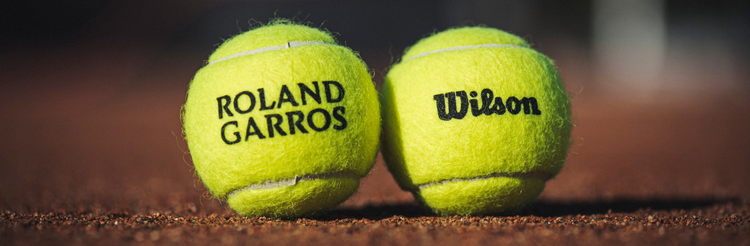
Ah, the joys of clay court tennis.
Crazy, inconsistent bounces.
Out-of-the-blue drop shots.
Long, grinding baseline points.
What do all these things have in common? The ball used to hit these shots.
All eyes are locked on the ball, and the anticipation of where it will go next is one of the most exciting things to witness, especially on this surface. Just scan the crowd during a point. Every head is traveling back and forth to follow the path of the ball.
Because every tennis court surface is so different, it only makes sense that specifically engineered balls are optimized for hard, clay, and grass courts. In honor of clay court season, let’s take a closer look a Wilson’s Roland-Garros clay court tennis ball, the very one used on the famed red clay in Paris.
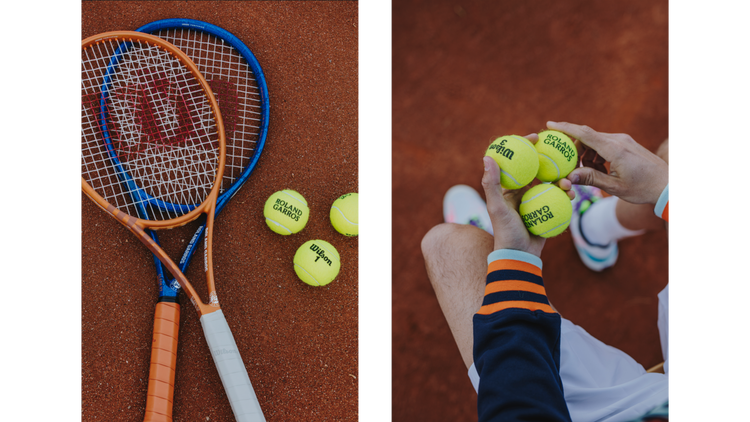
Why should you use a different ball on a clay court?
To begin, there are specific tennis balls for clay courts. The conditions, strategy and game style on clay are unique and drastically different than on hard and grass courts. The court is slower, the balls tend to bounce higher, and the rallies are (typically) much, much longer. For the ball to maintain its performance and durability, it must be specially designed and engineered to hold up even after long grinding points on a gritty clay-ridden surface. But what is the difference between hard court, grass court, and clay court balls? What makes a clay court ball unique?
Two main components: the ball’s felt and core.

The Felt
The top layer of a clay court consists of some sort of crushed material, whether it’s brick for red clay courts or metabasalt for green clay courts. Anyone who’s ever played on clay knows that this crushed material can sneak into everything you own and make them a little dirty. Because of this, it is important that clay court tennis balls use a felt that reduces the clay’s ability to become easily embedded in the outer layer of the ball. The engineers at Wilson found a felt that’s perfect for clay court tennis that limits dirt pick-up so the ball can maintain its consistency and visibility even after a typical long, grinding match. A bonus of this clay-specific felt is its water resistance treatment, which limits the amount of moisture that could otherwise saturate the felt and make it extremely heavy.
The Core
The inside of a tennis ball is just as important as the outside. As we learned earlier, the typical playing style of clay court tennis is long, grinding points and shots hit with heavy spin. There’s a ton of wear and tear on the ball, and it’s critical for it to hold up after several hitting sessions. To address this concern, Wilson’s engineers incorporated a 100% natural rubber core that offers maximum consistency and resiliency. It’s a slightly harder core than the one used in hard court balls, which allows it to last during longer rallies.

Check Out Our Roland Garros Tennis Balls Here
Wilson x Roland Garros
The French Open is the epitome of the clay court tennis season. Held each spring in Paris, France, Roland-Garros is one of the annual four Grand Slam tennis tournaments. This tournament goes way back, where the first event was held in 1891 and was only open to French club tennis players. Fast forward to today, and it now has a draw for nearly 20 divisions. There are players that travel from around the world for a chance to compete in the Chapionnats Internationaux de France de Tennis.
Since 2020, Wilson has partnered with Roland-Garros as the official ball of this historical tournament. We’ve worked together to create a co-branded, high-performance ball that’s perfect for clay court tennis. Approximately 65,000 tennis balls are used throughout the entire French Open tournament each year, and it’s important that each one is suitable for the biggest clay court tennis stage.
Chloe Lee, Wilson’s Advanced Materials Engineer, and Joanne Thomas-Kemp, Wilson’s Global Product Line Manager for Tennis Balls, discuss the research, engineering and extensive testing that goes into creating the very best ball for clay.