How Often Should I Re-String My Tennis Racket?
According to experts, when to restring depends on how often you hit the courts and how consistent you need your strings to be.

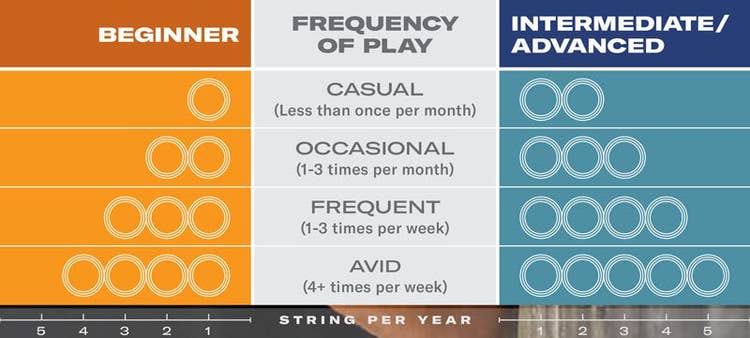
The old rule of thumb has always been to re-string your tennis racket as many times a year as you play in one week. Here's a more in-depth explanation:
Tennis Strings: How often should I re-string my racquet?
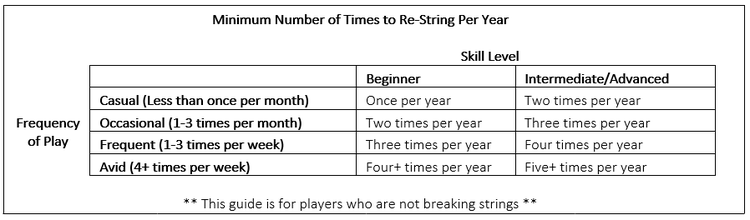
Your strings can impact your performance just as much as the racket you use. The old rule of thumb has always been to re-string your tennis racket as many times a year as you play in one week (Ex: If you play once a week, you re-string once per year). That model doesn’t consider players who are playing less than once a week, and most importantly, it’s not frequent enough. As a starting point, here’s a baseline guide with the minimum number of times you should re-string your racquet within a year:
Tennis String Theory: What other factors should I consider for re-stringing?
From the environment to how you play the game, there are so many variables that impact how often you should restring your racket.
TENNIS STRING TENSION LOSS
- Strings begin losing tension the moment your racket is taken off the stringing machine.
- As tension drops, you lose control and the ability to generate as much topspin especially if you play with a polyester tennis strings.
- In general, polyester tennis strings lose tension quicker than multifilament strings. They would require more frequent re-stringing.
ARM/ELBOW COMFORT LEVEL
- Strings lose their resilience over time, creating a stiff or dead feeling that can be harsh on your arm.
- A freshly strung racquet will absorb the shock better upon contact, providing more comfort.
- This is especially important if you have elbow or arm issues. If this is the case, you should consider re-stringing more frequently.
ENVIRONMENTAL CONDITIONS
- Natural gut absorbs moisture quicker in humid environments.
- Polyester tennis strings wear out even quicker when exposed to excessive heat or sun.
- On top of re-stringing, a tennis bag with Thermoguard lining will better protect your racket and strings.
STYLE OF PLAY
- Strings will wear out faster if you play more aggressively, use more spin, and/or primarily hit from the baseline.

How do I know when it's time to restring my tennis racket?
VISUAL INDICATORS YOU'RE OVERDUE TO RE-STRING:
NOTCHING
- Strings rub together as you hit the ball, creating friction.
- This leads to grooves at the intersection of the strings in the middle of the racket.
FRAYING
- Natural gut and multifilament strings are comprised of tiny fibers that eventually break down.
- Poly strings are a single filament, so they will not fray.

I am breaking tennis racket strings too often. What should I do?
TENNIS STRING GAUGE OPTIONS
- The thicker the gauge, the more durable it will be.
SWITCH TO HYBRID STRING
- If you’re playing with a multifilament string, consider switching to a polyester tennis string in the mains or crosses for more durability.
SWITCH TO POLYESTER (MONOFILAMENT) STRING
- Poly strings provide excellent durability since they are made of a single filament.
- However, they also lose tension quicker. This can require more frequent re-stringing for consistent performance.
- If you have arm/elbow issues, this may not be the best option due to its stiffer feeling.
Tip: As the performance of the string changes, you continually adjust your technique - whether you notice it or not. It can become frustrating to constantly overcompensate when the strings are no longer performing as they should. If you’re an avid player or competing in tournaments and looking for more consistent performance, you will want to consider re-stringing on a more regular basis.
I have multiple rackets. I primarily use one and have the other as a back-up so it doesn’t get played with as much. Do I need to re-string both every time?
Tip: If you carry multiple racquets, you ideally should re-string both every time. Even though you are primarily only playing with one racket, the strings in the other racquet are still losing their tension and resilience (just at a slightly slower pace). If you break the strings in your primary racket in the middle of the match and switch to your other racket, it will play very differently if it hasn’t been re-strung in a while.
Can I re-string my tennis racket on my own?
A stringing machine is required to re-string a tennis racket. For a racket to be strung at a specific tension, each main string (vertical) and cross string (horizontal) need to be individually pulled, and clamps are used throughout the process to hold the tension until a proper knot is tied at the end. If you are interested in stringing machines, you can learn more about our Wilson Baiardo stringing machines. Depending on which racket frame you have, the string pattern and instructions will vary.
Where can I find tennis racket stringing services?
There are a variety of places you can drop off your racket to have re-strung. Check your area for sporting goods stores, tennis specialty shops as well as tennis and country clubs. Additionally, you can ask around within your local tennis community to see who other players recommend, which could put you in touch with an at-home stringer. If you live near a Wilson retail store, you can take it there and have it strung on one of our Baiardo stringing machines.
To learn more about stringing, head to our "What String Tension Should I Use In My Tennis Racket" and "How To Choose a Tennis String" blog posts!
Updated February 15, 2023

/en-us/blog/tennis/team/roger-federer-new-tennis-racket-journey-innovation-and-legacy
The Making of Roger Federer’s New Tennis Racket: A Journey...
Discover the special tennis collection co-designed with legend Roger Federer: the RF Collection...

/en-us/blog/sportswear/wilson-labs/pro-staff-87-shoe-timeless-icon-reborn
The Pro Staff 87 Shoe: A Timeless Icon Reborn
Rediscover an icon. The Pro Staff 87 returns, blending timeless style with modern comfort for...

/en-us/blog/footwear/wilson-labs/introducing-new-rush-pro-45-tennis-shoe
Introducing the New Rush Pro 4.5 Tennis Shoe
Discover Wilson’s latest innovation in tennis footwear with the new Rush Pro 4.5 Shoes.